
Understanding the Sacred Beauty of the Anand Karaj
The Anand Karaj, meaning "blissful union," is one of the most profoundly moving wedding ceremonies we have the privilege of documenting. Introduced as a distinct Sikh wedding rite in 1909 and formally recognised in UK law in 2022, it is a ceremony of spiritual completeness rather than legal transaction. The couple is not merely joined to each other but, through the four Lavan (circumambulations) around the Sri Guru Granth Sahib Ji, they are bound to the path of Waheguru, the divine. Understanding this spiritual foundation is essential for anyone hoping to truly appreciate, plan, or photograph a Sikh wedding.
This guide walks through every key ritual of a traditional Sikh wedding in the UK, from the pre-wedding celebrations to the emotional farewell. We describe what to expect at each stage, what the rituals mean, and how we approach our photography at each moment to preserve the authenticity and depth of what is unfolding.
Pre-Wedding Ceremonies
The Roka and Kurmai (Engagement)
Before the main wedding proceedings begin, many Sikh families hold a Roka and Kurmai ceremony. The Roka is an informal family gathering where both families commit to the match, often involving prayers and the exchange of gifts. The Kurmai is the formal engagement ceremony, typically held at the Gurdwara, where the groom's father places a kara (steel bracelet) on the groom's wrist and gifts are exchanged between families. For some families, the engagement involves a simple Ardas (prayer) and Langar (communal meal), keeping the focus firmly on spiritual blessings rather than material display.
The Vatna and Ghara Gharoli
The Vatna is a turmeric paste ceremony performed separately at both the bride's and groom's homes. Family members apply a paste made from turmeric, yoghurt, and rose water to the skin of the bride and groom. Beyond its practical skin-brightening effect, the Vatna is a moment of intimate family gathering, often accompanied by singing and playful traditions. The Ghara Gharoli involves the fetching of sacred water from a river or lake by the groom's sisters-in-law, water that is later used in the wedding morning rituals. These are deeply personal ceremonies, often more emotionally raw than the formal wedding day itself, and we treat them with a photojournalistic, unobtrusive approach.
Mehndi Night
The Mehndi night is held at the bride's family home, typically two or three days before the main wedding. A henna artist applies intricate patterns to the bride's hands and feet, with the designs often incorporating the groom's initial hidden within the artwork for him to find on the wedding night. Guests sing traditional Punjabi folk songs, the atmosphere is joyful and boisterous, and the colour palette of saffron, magenta, and mustard yellow creates a visually rich environment that is a joy to photograph. We use high-speed off-camera flash to freeze the energy of dancing without blur, and wide aperture lenses to preserve the intimacy of quieter moments between the bride and her closest family.
The Jago
The Jago is perhaps the most chaotic and joyful of all the pre-wedding events. Typically held on the evening before the wedding, it involves the groom's female relatives parading through the streets carrying a decorated pot on their heads, singing and dancing to wake the neighbourhood and celebrate the forthcoming union. In UK settings, the Jago is usually contained to a venue or the family home's garden, but it retains its exuberant, high-energy character. We position ourselves to capture the sweeping motion of dancers, the expressions of laughing aunties, and the groom's bewildered delight from multiple angles simultaneously.
The Morning of the Wedding
Sehra Bandi: Tying the Groom's Turban
The wedding morning begins at the groom's home with the Sehra Bandi. The groom's Sehra (floral or beaded veil) is tied to the front of his turban by the nearest male relative, traditionally his maternal uncle. This is a private, intimate moment, often accompanied by prayers and emotional blessing from the family. We document this with quiet, respectful close-ups, capturing the hands of the relative tying the veil, the expression on the groom's face, and the circle of family elders gathered around him.
Baraat: The Groom's Procession
The Baraat is the groom's procession to the Gurdwara or venue, and it is one of the most visually spectacular moments of the entire wedding. Traditionally led by dhol players with the groom arriving on a white horse, UK Baaraats have evolved to include everything from vintage cars and open-top double-decker buses to motorcycles and horse-drawn carriages. The procession is accompanied by singing, dancing, and general celebration from the groom's party. We work with two photographers during the Baraat: one positioned at the destination to capture the arrival and reception, and one moving with the procession to document the journey and the groom's expressions throughout.
Milni: The Meeting of Families
Before the couple enters the Gurdwara, the Milni ceremony takes place at the entrance. Male relatives from both families meet and exchange garlands (malas) in a set order, beginning with the fathers, then uncles, then brothers and cousins. The exchanges are accompanied by warm embraces and, often, considerable good-humoured competition about who can lift whom off the ground. The Milni is visually rich and emotionally significant, marking the formal joining of two families. We position ourselves to capture both the formal garland exchanges and the candid laughter and tears that invariably follow.
The Anand Karaj Ceremony
Entering the Darbar Sahib
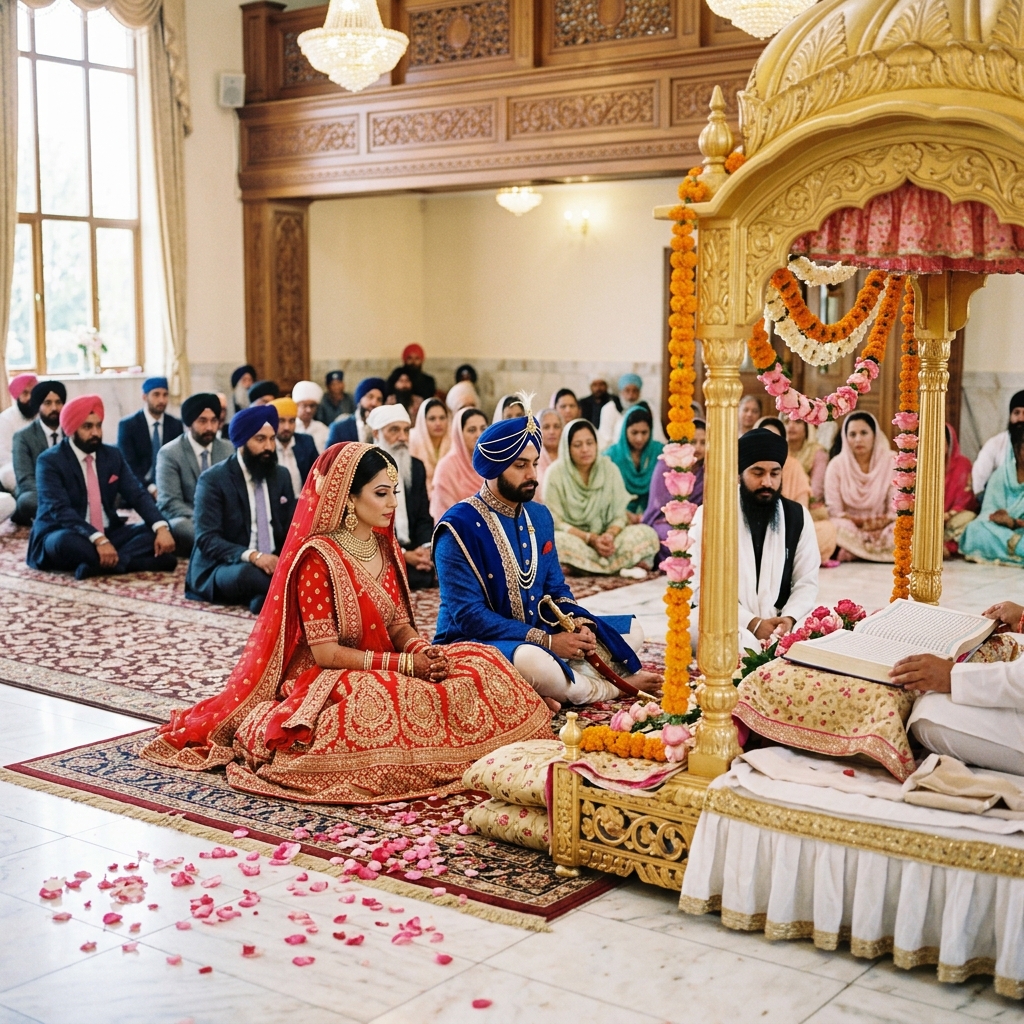
Before entering the Gurdwara, all guests cover their heads and remove their shoes. The atmosphere inside the Darbar Sahib is one of profound peace and reverence. The Sri Guru Granth Sahib Ji rests on the Palki Sahib (a decorated throne), and the Granthi (priest) reads from the scripture. We are always mindful of Gurdwara protocols: our cameras use silent shutters, we never step onto the raised platform of the Guru Granth Sahib Ji, and our clothing is respectful and appropriately covered. Building a relationship of trust with the Gurdwara committee before the wedding day is something we take seriously, as it enables greater documentary access during the ceremony.
The Four Lavan
The heart of the Anand Karaj is the Lavan, or the four circumambulations of the Guru Granth Sahib Ji. The Granthi reads each Lavan (verse) from the Guru Granth Sahib Ji while the Raagis (musicians) sing it to the congregation. After each verse, the couple, connected by the groom's palla (sash) which the bride holds, rises and walks clockwise around the Palki Sahib together. The four Lavan represent four stages of the soul's journey toward divine union: righteousness, longing, detachment, and spiritual bliss.
The moments during the Lavan are among the most photographically and emotionally intense of the entire wedding. We use long telephoto lenses from respectful positions to capture the couple's expressions, the connection between their hands on the palla, and the faces of parents and grandparents in the congregation as they witness their children completing each circumambulation.
"The four Lavan are not just a walk around the scripture. They are a vow of the soul. We try to capture not just the image but the weight of what is happening in those moments."
The Ardas and Hukamnama
Following the four Lavan, the congregation stands for the Ardas, a collective prayer. The Granthi then reads the Hukamnama, a random verse from the Guru Granth Sahib Ji that serves as divine guidance for the newly married couple. Karah Prashad (sacred sweet pudding made from flour, butter, and sugar) is distributed to all present. These final moments of the ceremony carry a quiet, collective spirituality that is deeply moving to witness and document.
Post-Ceremony Celebrations
Family Portraits at the Gurdwara
Immediately after the ceremony, while the couple is still in their full ceremonial dress and the Gurdwara is beautifully lit, we prioritise family portraiture. The sequences typically include immediate family groupings on both sides, full family photos, the couple alone with different backdrops, and a set of formal images in the Darbar Sahib itself (where protocols permit). We recommend allocating at least forty-five minutes to this immediately post-ceremony, before guests begin dispersing to the reception venue.
The Doli: The Bride's Farewell
The Doli, or the bride's departure from her family home, is one of the most emotionally charged moments of any Sikh wedding. As the bride leaves her family behind to join her husband's household, tears flow freely. We approach this with immense sensitivity, using longer lenses to give the family genuine privacy while still preserving the memory. We never direct or organise this moment. We simply observe, wait, and document with absolute respect.
The Milni at the Reception Venue
A second, less formal Milni often takes place at the reception venue where the groom's family welcomes the bride to her new home. This is followed by the grand reception with dancing, the couple's formal entrance, speeches, and the Langar or wedding feast. Our second photographer remains focused on capturing the high-energy reception atmosphere while our lead photographer stays close to the couple for formal and editorial portrait opportunities throughout the evening.
Sikh Wedding Photography: Our Approach
- We always obtain advance permission from the Gurdwara committee and respect all protocols without exception.
- Silent shutter mode is used throughout the Darbar Sahib to preserve the sacred atmosphere.
- We use a dual-photographer approach to ensure simultaneous coverage of the groom's Baraat preparations and the bride's morning routine.
- Telephoto lenses during the Lavan allow respectful distance while preserving the emotional intimacy of the portraits.
- The Doli is documented from a respectful distance with longer focal lengths, never intrusive.
- We brief all family members before portrait sessions to minimise waiting time and maximise the quality of groupings.
Share a detailed ceremony timeline with us at least four weeks before the wedding. Knowing exactly when the Baraat is expected, the anticipated duration of the Lavan, and the planned time of the Doli allows us to position ourselves perfectly for every critical moment without disrupting the flow of your day.
Understanding Sikh Wedding Traditions to Cherish Them
Every family approaches these traditions with their own cultural nuance, regional variation, and personal significance. Some families observe all the pre-wedding events with full ceremonial formality; others adapt certain traditions to suit modern lifestyles. What is constant is the spiritual core of the Anand Karaj itself, the commitment made before Waheguru and the congregation, and the beauty of the palla connecting two people beginning their shared journey.
We consider it a privilege to document these moments. If you are planning a Sikh wedding and would like to speak with us about our approach, our experience of specific Gurdwaras in Leicester and the Midlands, or how we handle multi-day Sikh celebrations, we would love to hear from you.
See our Sikh wedding photography portfolio or enquire about your date today.