
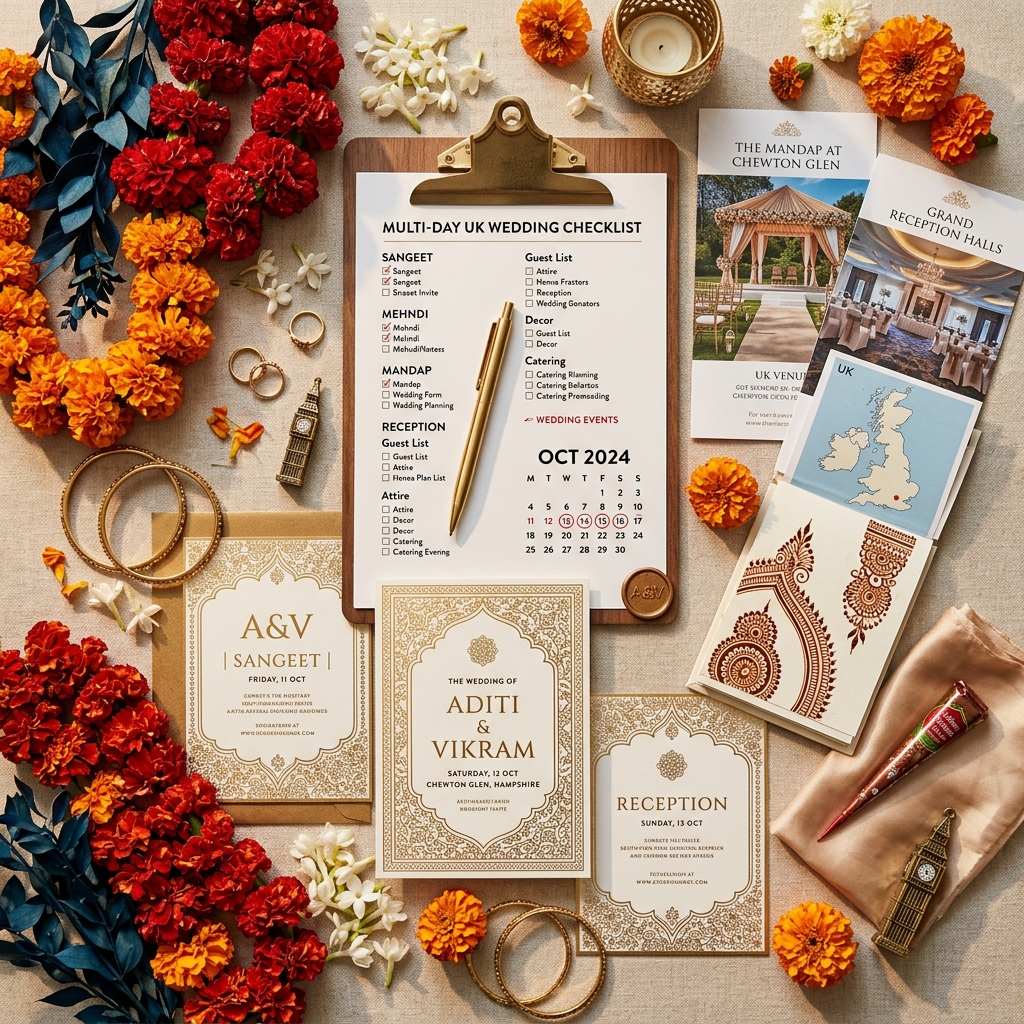
The Reality of Planning a Multi-Day South Asian Wedding in Britain
A South Asian wedding in the UK is not a single event. It is a multi-day, multi-venue, multi-vendor marathon of cultural celebration that typically spans three to five days and involves hundreds of moving parts. From the intimate Haldi ceremony at the family home on Wednesday afternoon to the thunderous Baraat procession on Saturday morning and the grand reception on Saturday evening, each event has its own dress code, guest list, catering requirement, and logistical framework.
The couples who remember their wedding as magical, seamless, and stress-free are almost universally the ones who planned with structure and generosity of time. The couples who remember it as chaotic are usually the ones who underestimated how many decisions needed to be made and how far in advance they needed to make them. This guide distils years of experience coordinating with families across the UK into a practical, actionable planning framework.
Building Your Master Timeline: The Foundation of Everything
Before you book a single vendor, your first task is to build a master timeline that spans from your initial planning phase all the way through to your honeymoon departure. This timeline becomes the spine of your entire planning process, and every vendor you engage should eventually receive a version of it.
18 to 24 Months Before the Wedding
- Agree on approximate guest numbers with both families
- Determine which events you are hosting and at which venues
- Begin venue shortlisting for the main reception
- Hire your photographer and videographer (good teams book up quickly)
- Set an overall budget and assign allocations to each category
- Agree on the wedding date (aligning with religious calendars if required)
12 to 18 Months Before
- Secure your main venue with a signed contract and deposit
- Book your Gurdwara, mandir, or mosque for the religious ceremony
- Engage your décor and floral design team
- Begin bridal wear research and initial consultations
- Commission your stationery designer for save-the-dates
- Book your catering team or confirm venue catering arrangements
- Hire your music: dhol players, DJ, live band as required
6 to 12 Months Before
- Finalise your bridal lehenga or saree and place your order
- Send formal invitations (especially for overseas guests requiring visa applications)
- Book accommodation blocks for out-of-town guests
- Confirm your makeup and hair team and schedule a trial session
- Meet with your photographer to build the detailed day-by-day shot list
- Complete your civil ceremony registration if required
- Finalise menu selections and dietary requirement lists
1 to 3 Months Before
- Send your master timeline to every vendor simultaneously
- Conduct a venue walk-through with your photographer and décor team together
- Confirm all vendor arrival times in writing
- Prepare a family coordinator or assign a trusted point of contact for each event day
- Build buffer time into every session: a minimum of thirty minutes per transition point
- Confirm the Baraat route and parking logistics with the venue
"The couples who build thirty-minute buffers into every transition never miss a moment. The ones who do not spend their wedding day running."
Day-by-Day Event Planning
Day One: Haldi Ceremony
The Haldi is typically held at the bride's or groom's family home and is one of the most photographically rich, emotionally genuine events of the entire wedding. Guests arrive in yellow or white (turmeric stains, after all), and the atmosphere is intimate and chaotic in the best possible way. For this event, you need minimal formal planning: simply ensure there is enough outdoor or well-lit indoor space, a clean backdrop for the couple's Haldi application, and a designated area where guests can participate without crowding the key moments.
Planning tip: Hire a professional photographer for the Haldi even if your main wedding photographer is not part of your package. The candid, unposed moments during the turmeric application are some of the most treasured images our couples request in their final galleries.
Day Two: Mehndi and Sangeet
The Mehndi and Sangeet are often combined into a single evening event or held on consecutive days depending on family preference. The Sangeet is a music and dance celebration where both families perform choreographed dances, lip-sync routines, and sometimes live musical performances. Planning a successful Sangeet requires advance organisation of the performance running order, a rehearsal space for family dance groups, and a reliable AV setup at the venue.
The Mehndi portion requires a professional henna artist booked at least six months in advance (the best artists are extremely sought after), a comfortable seating arrangement for the bride and her guests, and good lighting for the artist to work. We advise scheduling the bride's Mehndi early in the evening so the design has time to dry and darken before she sleeps.
Photography consideration: Ensure your photographer knows the Sangeet running order well in advance. Performance lighting is very different from ambient social lighting, and switching between the two without preparation leads to missed moments.
Day Three: The Wedding Ceremony
The main ceremony day is where all your planning either pays off or exposes its gaps. We recommend building your ceremony day timeline with these key anchor points:
- Bridal preparation: 5 to 6 hours before the ceremony start time. Makeup, hair, jewellery, and final outfit takes longer than most couples anticipate.
- Groom preparation: 2 to 3 hours before the ceremony. The Sehra Bandi and family blessings need generous time.
- Travel buffer: 30 to 45 minutes beyond your expected journey time between home and venue. Traffic, parking, and last-minute moments always eat into this.
- Pre-ceremony portraits: 20 to 30 minutes at the venue before guests arrive, if your venue permits.
- Post-ceremony family portraits: 45 to 60 minutes immediately after the ceremony while everyone is still assembled.
- Couple portrait session: 30 to 45 minutes during the reception, ideally at golden hour if your timing allows.
Day Four: The Reception or Walima
The reception is your grandest social event: typically a formal dinner for the full guest list, with the couple's grand entrance, speeches, first dance or garland exchange, and dancing. If your wedding included a separate religious ceremony the day before, the reception allows the full guest list to celebrate together in a less formal, more festive atmosphere. Key planning considerations for the reception include: confirming the running order with the DJ and MC at least two weeks in advance, coordinating the catering service timings to avoid food arriving during speeches, and ensuring the first dance or couple moment is clearly communicated to the venue manager and photographer.
Vendor Coordination: The Critical Conversations
The single biggest cause of wedding day stress is poor vendor communication. Here is what every key vendor needs from you, and when they need it:
Your Photography and Videography Team
Your photography team needs to know:
- The confirmed timeline for every event they are covering, with addresses and postcodes
- Who the family coordinator is for each event (the person they should contact if something changes on the day)
- A full list of the formal portrait groupings required, ideally organised by family side
- Any special cultural or religious moments that must not be missed
- Gurdwara, mandir, or mosque-specific photography protocols
- Whether there is a civil ceremony and when it takes place
Your Décor and Floral Team
Décor teams require early access to the venue for setup, which means they need to coordinate their installation window with the venue manager well in advance. Ensure your venue contract specifies the earliest permitted access time. Share the photography team's requirements with your décor team: knowing where we position for ceremony shots, for example, allows them to avoid placing tall centrepieces that would obstruct our sightlines to the stage.
Your Catering Team
Whether you are using a venue's in-house catering or an external South Asian caterer, the service timeline must be coordinated with the running order of the event. Food should never arrive during a first dance, a speech, or a key ceremonial moment. Provide your caterer with a finalised running order at least three weeks before the event, and appoint a family member as the caterer's point of contact on the day.
Managing Family Dynamics During Planning
South Asian wedding planning is, inevitably, a family affair. Both sets of parents, multiple aunts and uncles, grandparents, and community elders all have opinions, traditions they consider non-negotiable, and expectations about their role in the celebration. Managing this respectfully and efficiently is perhaps the most demanding non-logistical challenge of the entire process.
Our practical advice: appoint one or two trusted family decision-makers from each side who have the authority to make final calls on behalf of their respective families. Avoid decision-by-committee on every detail. Create a clear channel for family input but establish that the couple has the final word on key creative and logistical decisions.
Create a WhatsApp group with your lead photographer, both family coordinators, your venue manager, and your décor lead at least one month before the wedding. Use it for real-time updates on the day. A message saying "Baraat is running 20 minutes late" gives us the ability to adjust without missing a beat.
The Well-Being Plan: Looking After Yourselves
With five days of events, multiple outfit changes, and the emotional weight of the most significant celebration of your lives, physical and emotional exhaustion are genuine risks. We have seen couples arrive at their reception photographs visibly drained because they had not eaten, had not slept, or had spent every moment of the preceding days managing other people's expectations.
- Build rest breaks into the main ceremony day: A thirty-minute private window for the couple between the ceremony and the reception is invaluable. Use it to eat, breathe, and reconnect.
- Eat before the events begin: At every event, designate a family member to bring you food before the public celebrations start. Couples rarely get to the dinner table.
- Delegate ruthlessly: Not every decision on the day is yours to make. Trust your vendors to execute what you have planned together.
- Protect the morning of the main ceremony: Keep this time as calm as possible. Limit visitors to the bridal prep room to essential people only.
Conclusion: Plan with Time, Execute with Trust
The multi-day South Asian wedding is one of the most spectacular celebrations in the world. When planned with sufficient time, clear communication, and generous buffers built into every transition, it unfolds with a grandeur and warmth that creates lifelong memories for everyone present. When it is rushed, under-planned, or coordinated in silos, the cracks show on the day and in the photographs.
We work with our couples as partners from the moment they book, helping to build timelines, flag potential conflicts, and prepare for the unexpected. If you are in the early stages of planning your multi-day wedding and would like a conversation with a team that has navigated hundreds of these celebrations, we would love to hear from you.
Explore our UK-wide Asian wedding photography services or begin your enquiry today.