
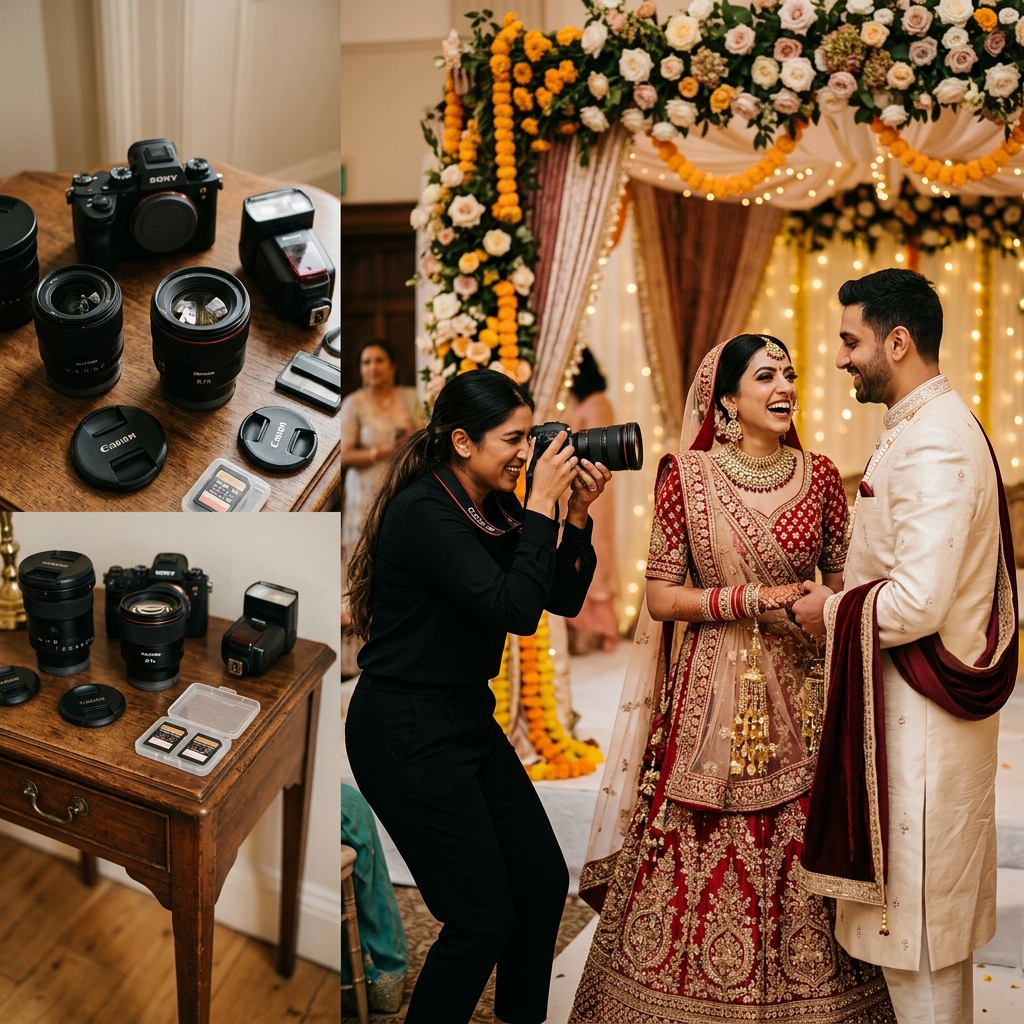
Why a Shot List Is Not Optional for Asian Weddings
Asian weddings are among the most complex, multi-layered events a photographer will ever document. Unlike a registry office ceremony that might unfold in forty minutes, a South Asian wedding can span multiple days, involve ten or more discrete ceremonies, require navigation of sacred religious spaces, and demand simultaneous coverage of events happening in separate rooms or venues. Without a detailed, agreed shot list, moments get missed. Families feel unrepresented. Couples discover gaps in their gallery that cannot be recreated.
This checklist is the result of years of experience photographing Sikh, Hindu, Muslim, and Gujarati weddings across Leicester, Birmingham, London, and the wider UK. We share it with our couples at the planning stage and use it as a living document that we refine together in the weeks leading up to the wedding. Use it as a starting point for your own conversations with your photography team.
Before the Wedding: Pre-Shoot and Pre-Wedding Ceremonies
Engagement and Pre-Wedding Portrait Session
A pre-wedding portrait session (often called an "e-shoot" or "engagement session") is one of the most valuable investments a couple can make before their wedding. It serves three critical functions: it allows you to build a relaxed, natural rapport with your photographers before the pressure of the main day, it produces beautiful images for your wedding stationery or guest welcome displays, and it gives us an opportunity to understand how you move, interact, and respond to direction so we can adapt our approach for the wedding itself.
What to capture in a pre-wedding session:
- Relaxed couple portraits in natural settings (parks, countryside, urban backdrops)
- Outfit detail shots: jewellery, shoes, watch, mehndi designs if already applied
- Candid walking, laughing, and interacting shots
- A golden-hour portrait sequence
- Location-specific editorial shots that tell a story about where you are from or where you met
Haldi Ceremony Checklist
- Wide establishing shot of the setup: the family home or garden, the turmeric bowls, the gathering guests
- The bride or groom seated before the ceremony begins
- First application of turmeric paste (typically by the mother)
- Sequence of different family members applying the Haldi
- Close-up detail of the turmeric being applied to hands, face, and arms
- The bride or groom's expression throughout
- Candid reactions from the family circle
- Playful moments where guests get involved in the turmeric chaos
- Final portrait of the bride or groom covered in Haldi with close family
Mehndi Night Checklist
- The mehndi artist setting up
- Close-up detail of the mehndi design in progress at various stages
- The bride's hands and feet at completion, beautifully lit
- Wide shots of the full gathering atmosphere
- The bride surrounded by her bridal party and sisters
- Sangeet performances and dancing (if combined evening)
- Family singing traditional folk songs
- Detail shots: the decorated space, the food spread, the jewellery laid out
- Candid laughter between the bride and her guests
Wedding Morning: Bridal and Groom Preparation
Bridal preparation is where we spend a significant portion of our morning, and for good reason. The getting-ready sequence produces some of the most intimate, emotionally resonant images of the entire wedding. These are quiet moments before the world arrives, and they deserve to be documented with care.
Bridal Preparation Checklist
- Wide establishing shot of the prep room before hair and makeup begins
- Hair and makeup artist at work, bride in the chair
- Close-up of the makeup application: eyes, lips, contouring
- Jewellery laid out flat on a white or neutral surface before being put on
- Mother helping the bride with her maang tikka or necklace
- Sisters or bridesmaids helping with the dupatta or saree
- Full portrait of the bride in her outfit before leaving for the venue
- Detail shots: bridal shoes, bangles, mehndi, the back of the blouse
- Emotional moments: the mother's reaction seeing the bride ready, tears, prayers
- The bride looking at herself in the mirror for the first time in full attire
- Candid moments with the bridal party during preparation
- Invitation suite or bouquet detail shots
Groom Preparation Checklist
- Groom getting dressed, sherwani being buttoned or adjusted
- Sehra Bandi: the tying of the floral veil to the turban by the maternal uncle
- The father straightening the groom's collar or making a final adjustment
- The groom's Pagri (turban) being tied by a family elder
- Detail shots: kara bracelet, shoes, watch, pocket square
- Family prayers before departure
- Groom's full-length portrait
- The groom with his brothers, male cousins, and close friends
- Groom with parents before the Baraat departs
The Ceremony
Baraat and Milni Checklist
- Baraat procession wide shot: the full group arriving
- The groom's arrival mode (horse, car, open-top vehicle)
- Dhol players and bhangra dancers in action
- The groom's expression during the procession
- Close family dancing around the groom
- The bride's side waiting at the entrance
- Milni garland exchanges between matching relatives from each family
- The emotional father-to-father embrace
- Candid laughter during the Milni lifting traditions
- Formal family line-ups at the entrance after the Milni
Anand Karaj Ceremony Checklist
- The Darbar Sahib wide shot showing the full sacred space
- The Palki Sahib (throne of the Guru Granth Sahib Ji)
- Granthi reading the scripture
- The couple being seated together before the ceremony begins
- The palla (sash) being placed in the bride's hands
- Each of the four Lavan circumambulations
- Guests watching with reverence from the congregation
- Parents' faces during the ceremony (reactions of joy, tears, pride)
- The Ardas prayer
- Distribution of Karah Prashad
Hindu Vivaha Ceremony Checklist
- The mandap wide shot before the ceremony, showing the full décor
- The Ganesh Puja that opens the ceremony
- The Jaimala (garland exchange) between the couple
- The Saptapadi: the seven steps around the sacred fire
- Sindoor ceremony: the groom applying vermillion to the bride's parting
- The Mangalsutra being placed around the bride's neck
- The sacred fire (Agni) close-up
- The priest performing the rituals
- Parents and grandparents watching
- The Vidaai: bride's departure and farewell with family
Nikah Ceremony Checklist
- The arrival at the mosque or ceremony venue
- The Qazi (officiating cleric) taking his seat
- Male and female sections if applicable
- The Nikah contract signing by the groom
- The Mehrmana (witness) signatures
- The bride's Qubool Hai (acceptance of the marriage)
- Prayers after the completion of the Nikah
- Congratulations from the families
- The couple together after the ceremony in their formal attire
Family Portraits: A Structured Approach
Family portrait sessions are where poor planning causes the most frustration. With dozens of groupings required and family members dispersing the moment the ceremony ends, having a clear, pre-communicated sequence is essential. We ask every couple to provide their family portrait list at least two weeks before the wedding, organised by family side.
A typical South Asian wedding family portrait sequence includes:
- Couple alone (multiple setups: formal, editorial, romantic)
- Couple with immediate family on bride's side (parents and siblings)
- Couple with paternal grandparents on bride's side
- Couple with maternal grandparents on bride's side
- Full bride's family: all aunts, uncles, cousins
- Same sequence repeated for groom's side
- Both immediate families together
- Full group (all guests): only if venue and time permit
Appoint a dedicated family coordinator for the portrait session: someone from each side of the family who knows all the relatives and can gather the right people quickly. This person is worth their weight in gold. Without them, a thirty-grouping portrait session can take ninety minutes. With them, it takes thirty.
Reception and Evening Celebration Checklist
- The reception venue before guests arrive (décor detail shots)
- Centrepiece details: flowers, candles, table settings
- The couple's grand entrance
- First dance or garland exchange at the reception
- Parent speeches (reactions from the crowd as well as the speakers)
- The couple's first meal together
- Candid dancing: wide shots of the floor, detail shots of individual dancers
- Dhol players in action at the reception
- Cake cutting if applicable
- Final couple portrait at the end of the evening
- Candid farewell moments between the couple and key guests
Specialist Cultural Details: Never Miss These
Beyond the standard ceremony shots, these cultural detail moments are the ones that distinguish a truly comprehensive Asian wedding gallery:
- The wedding outfit details: The intricate embroidery of the lehenga or sherwani, the dupatta pinning, the weight and drape of the fabric.
- Jewellery close-ups: Maang tikka, nath (nose ring), Kaan chain, bangles and kadas laid together before being worn.
- Religious symbols: The Kirpan, the sacred thread (Janeu), the Qur'an on the Nikah table, the Diyas at a Hindu ceremony.
- Feet details: The bride's alta (red dye) or silver toe rings against the mehndi.
- Generational moments: The grandmother placing her hand on the bride's head in blessing, the grandfather presenting a gift.
- The wedding spread: Buffet detail shots, the Langar at the Gurdwara, the Walima feast.
After the Wedding: Ensure Your Gallery Is Complete
After receiving your gallery, we recommend reviewing it against this checklist with your family. If there is a particular grouping or moment you cannot find, contact your photographer immediately while the context is still fresh and while any recreations (where appropriate) might still be possible.
A comprehensive Asian wedding gallery typically contains between eight hundred and fifteen hundred carefully edited images across a full multi-day coverage. Every image we deliver has been colour-graded, exposure-corrected, and retouched to our editorial standard. We do not deliver unprocessed files or quantity over quality.
Working With This Checklist
Download or save this checklist and use it as the basis for your first detailed conversation with your photographer. Share your cultural traditions, your specific family dynamics, and any particularly precious moments that you are most anxious to preserve. A great photographer does not just follow a checklist mechanically; they use it as a framework and then adapt in real time to the unpredictable, beautiful moments that no planning document can anticipate.
If you have questions about how we approach any of the moments listed here, or if you would like to discuss a specific ceremony or cultural tradition we have not covered, we are always happy to have that conversation.
View our full UK Asian wedding photography services or enquire about your wedding date.